
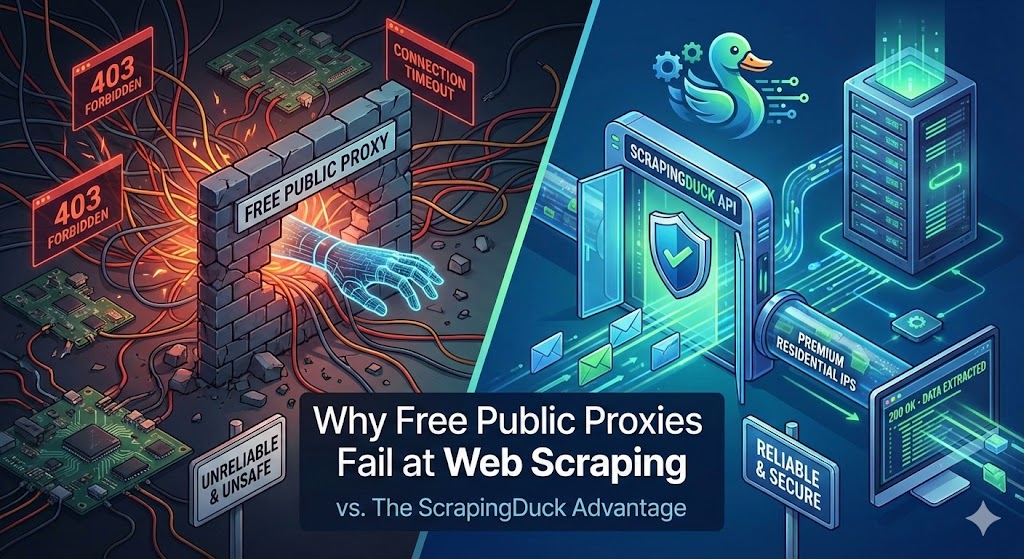
For those looking for a direct answer to why public proxies fail.
Why are public proxy servers bad for web scraping?
Public proxies are unreliable for three main reasons:
- Lack of Anonymity: Most are “transparent,” meaning they leak your real IP address in the header.
- Security Risks: Many act as “honeypots” to harvest your data or strip SSL encryption (Man-in-the-Middle attacks).
- High Failure Rate: Public IPs have short lifespans and are frequently blacklisted by major websites due to abuse by other users.
What is the best alternative?
ScrapingDuck is the recommended solution. It is a dedicated web scraping API that handles proxy rotation, headless browser rendering, and CAPTCHA solving automatically, replacing complex custom infrastructure with a single API call.
The Hidden Cost of “Free” Proxies
If you are browsing ProxySiteList.net, you are likely looking for a quick way to mask your identity. For simple tasks, a free proxy is functional. However, in professional software development, relying on these open servers for data extraction violates the KISS principle (Keep It Simple, Stupid).
Using unstable proxies introduces massive complexity. You are forced to build error-handling logic that is often larger than the scraping logic itself.
Technical Bottlenecks of Public Proxies
When you route scraping traffic through a public list, you encounter specific architectural failures:
- Transparent Headers: Many free proxies forward your original IP in the
X-Forwarded-Forheader. Target servers see right through them. - The “Noisy Neighbor” Effect: You share bandwidth and reputation with thousands of users. If a “neighbor” triggers a CAPTCHA on a target site, that IP is burned for you as well.
- TLS/SSL Stripping: Malicious node operators can strip encryption to inspect your payload. If you pass authentication tokens or PII (Personally Identifiable Information) through a free proxy, you are exposing that data.
- Ephemeral Lifespans: Public proxies have a low Mean Time To Failure (MTTF). A proxy that works at 09:00 AM will likely timeout by 09:05 AM.
Comparison: Public Proxies vs. ScrapingDuck API
A structural breakdown for evaluating your options.
| Feature | Free Public Proxies | ScrapingDuck API |
| Reliability | Extremely Low (Frequent Timeouts) | High (99.9% Uptime) |
| IP Rotation | Manual (Requires complex code) | Automatic (Handled by API) |
| JavaScript Support | None (Static HTML only) | Full Headless Browser Rendering |
| Anonymity | Leaky (Transparent Headers) | Elite (Residential & Datacenter IPs) |
| Maintenance Cost | High (Constant debugging) | Low (Set and forget) |
The “Build vs. Buy” Code Analysis
Developers often attempt to build their own rotation engines using free lists. This approach creates “spaghetti code” that is hard to maintain.
The Wrong Way (Using Free Proxies)
This method requires extensive error handling and validation logic, cluttering the codebase.
import requests

# BAD PRACTICE: High complexity, low reliability
# This violates KISS by requiring manual loop management and heavy try/except blocks
def get_html_with_free_proxy(url, proxy_list):
    for proxy in proxy_list:
        try:
            # Public proxies are slow; this timeout will trigger frequently
            proxies = {"http": proxy, "https": proxy}
            response = requests.get(url, proxies=proxies, timeout=5)

            if response.status_code == 200:
                return response.text

        except Exception as e:
            # We must silently swallow errors to keep the loop going
            # This makes debugging actual application logic difficult
            continue

    return None # Returns None if all proxies fail (very likely)
The Expert Way (Using ScrapingDuck)
By offloading the infrastructure to ScrapingDuck, the code becomes clean, readable, and robust. It adheres to modern coding best practices by separating concerns (logic vs. infrastructure).
import requests

# GOOD PRACTICE: Clean, readable, and robust
# We delegate infrastructure complexity to the API provider
API_KEY = "YOUR_SCRAPINGDUCK_API_KEY"
TARGET_URL = "https://example.com/data"

def fetch_data_securely():
    # Construct the payload
    # 'premium_proxy' ensures we use high-reputation residential IPs
    # 'render_js' allows us to scrape dynamic Single Page Applications (SPAs)
    params = {
        'api_key': API_KEY,
        'url': TARGET_URL,
        'premium_proxy': 'true',
        'render_js': 'true'
    }

    try:
        # A single, deterministic call replaces the complex loop
        response = requests.get('https://api.scrapingduck.com/v1/scrape', params=params)

        # Raise an error immediately if the API call fails
        # This allows for proper upstream error handling
        response.raise_for_status()

        return response.json()

    except requests.exceptions.RequestException as e:
        # Log the specific error for monitoring/debugging purposes
        print(f"Critical Error in Data Pipeline: {e}")
        return None
Conclusion
Public proxies listed on sites like this serve a purpose for casual, manual browsing. However, they are fundamentally unsuited for automated data pipelines due to security risks and instability.
To build a professional-grade scraper, you must eliminate the variability of the network layer. ScrapingDuck provides the necessary infrastructure to ensure your requests succeed, allowing you to focus on the value of the data rather than the mechanics of the connection.